


Better Stroke Recovery at 90 Days: The Power of Tenecteplase Explained
Stroke is a medical emergency that can cause permanent disability or even death. Doctors used to think that treatment had to be given very quickly, usually within 4.5 hours, for it to work. But a new study has given us hope. It shows that Tenecteplase, a drug that breaks up blood clots, can still help patients get better even if they take it between 4.5 and 24 hours after certain types of stroke.
This is an important finding because a lot of people don’t get to the hospital in time. This new method could save more lives and brain functions.
What a Stroke Is and How Tenecteplase Works
When blood flow to a part of the brain is blocked or slowed down, a stroke happens. This is called an Ischemic Stroke, and it is the most common type. Brain cells die when blood can’t get to them. But not all brain cells die right away. Some areas are still at risk but can be saved if treatment is given quickly.
Tenecteplase is what helps here. This drug is also called a thrombolytic because it breaks up clots. Its main job is to break up the clot that is blocking blood flow so that oxygen and nutrients can get to the brain again.
People have used a different drug called Alteplase in the past. Tenecteplase, on the other hand, is becoming more popular because it is easier to give (a single injection instead of a longer infusion) and may work just as well, or even better in some cases.
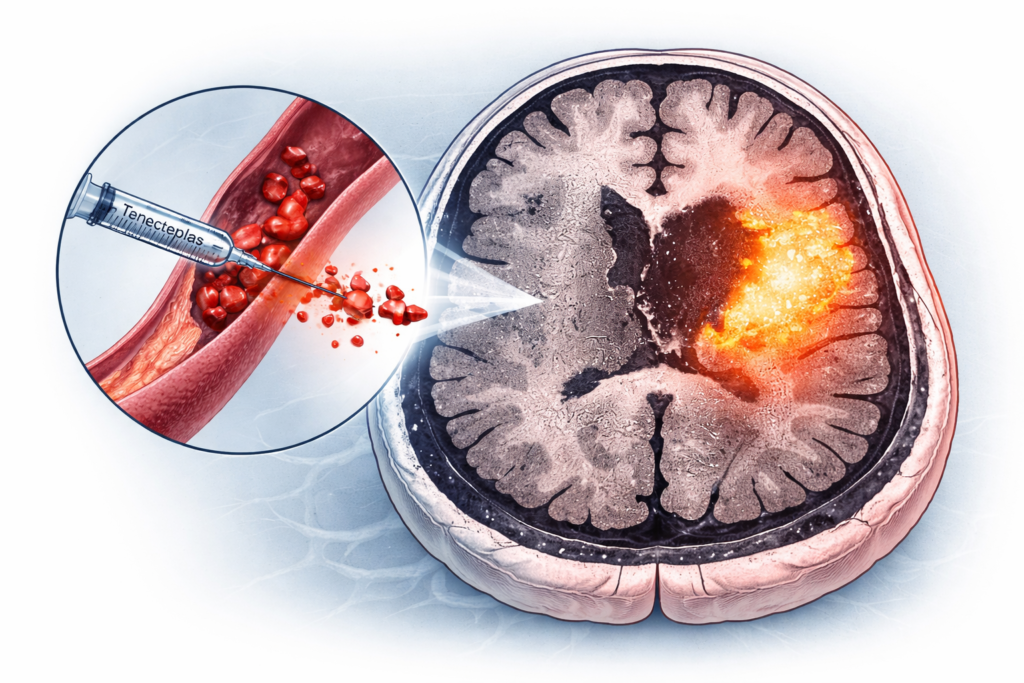
The new study looked at patients who still had “salvageable brain tissue.” This means that even though part of the brain was damaged, some parts had not yet died and could still heal if blood flow was restored.
How This Study Changes How Strokes Are Treated
The study showed that giving Tenecteplase between 4.5 and 24 hours after a stroke made it more likely that the person would recover well in 90 days. This is a big step forward for stroke care.
Before this, a lot of patients who got to the hospital late were told they were outside the treatment window. Doctors can now use advanced brain imaging to find patients who still have brain tissue that can be saved. Late treatment with Tenecteplase may help these patients.
This doesn’t mean that everyone who has a stroke should wait to go to the hospital. The best choice is still to get treatment early. The better the outcome, the faster a patient gets care. The saying “time is brain” is still true.
But this study gives hope to people who can’t get help right away. It also shows how important modern scanning methods are, which help doctors decide when to start treatment.
This study shows that stroke treatment is getting better, to put it simply. Now, even hours after symptoms start, more patients have a second chance to get better.
Stroke is still a dangerous condition, but new medical discoveries are changing that. Using Tenecteplase outside of the usual time frame gives new hope for a better recovery. Get medical help right away if you or someone you know shows signs of a stroke, like sudden weakness, confusion, or trouble speaking. Quick action can save a life, and now even treatment that is delayed may still help.